

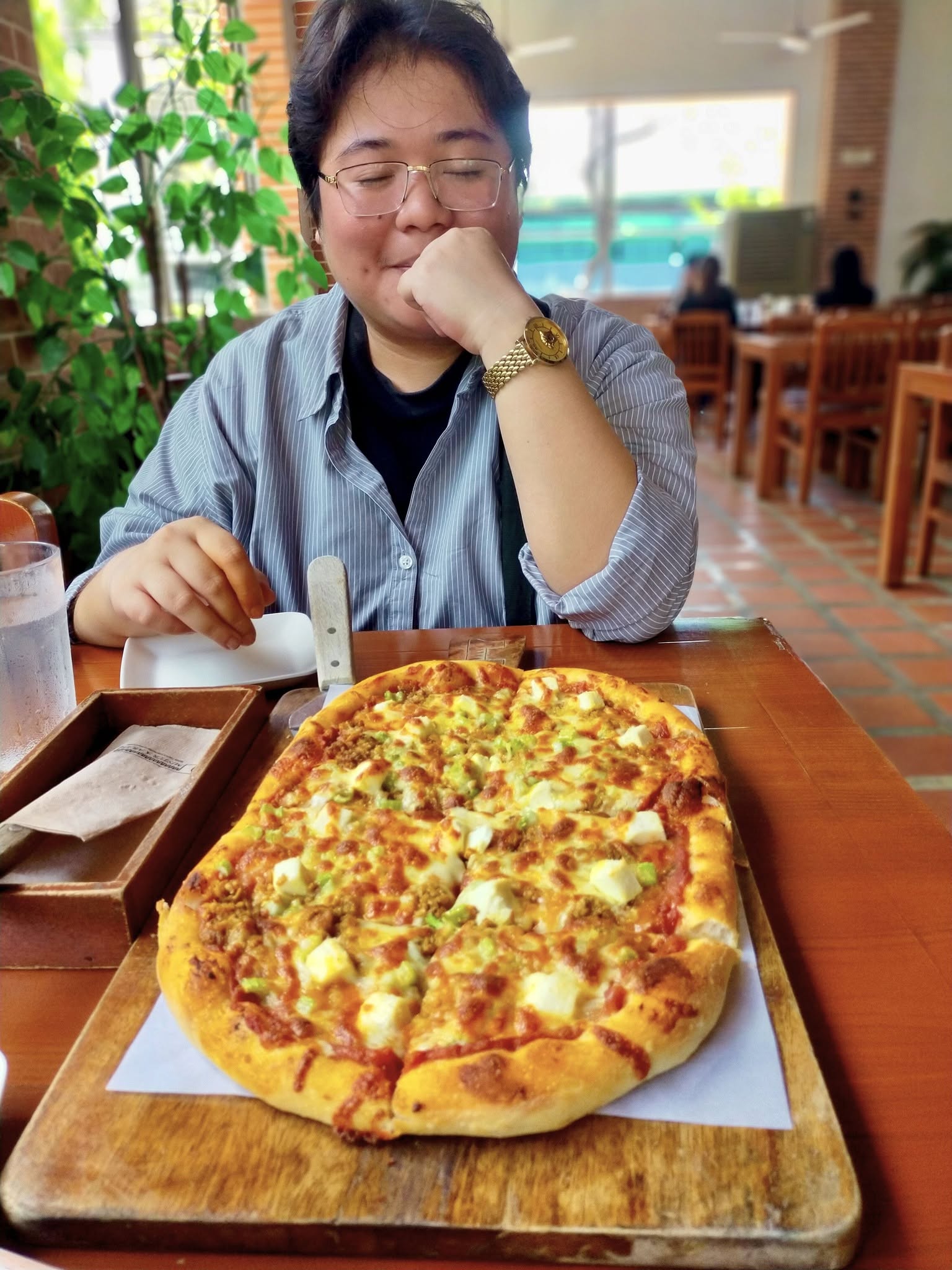
Happiness, which always comes from within, is a skill as visceral as any other skill, such as spreadsheets, Figma, and copywriting, as visceral as any sense, such as sight or hearing.
The youth are the future. A signage business owner once said to me, “Ang kabataan ay ang kinabukasan,” and he went on to explain how his sons spend time in London, United Kingdom, sometimes for leisure, sometimes for business, and sometimes for both. I agree with him.
The youth are the future because they are the heirs of truth, like an heirloom passed down from generation to generation. If we are discussing the different dimensions of philosophy, as ancient as physics and the other natural sciences, perhaps truth has a reason of its own. It demands to be felt in the bones and marrow of our being, in our very DNA as a species that mirrors God’s purpose in our creation and, therefore, our stewardship of the earth. Perhaps what distinguishes us from all other creations is our discernment and natural inclination toward truth, like greatness bowing before children, like a great tree bending to give shade.
My favorite places in the entire world are Cairo in Egypt, Paris in France, Dubai in the UAE, and Commonwealth in Quezon City because of the inauguration of the Commonwealth of the Philippines by one of my favorite presidents, President Manuel L. Quezon.
I spend my days studying agriculture, and other subjects. When I go outside, I watch and learn, guided by what I have read and what my mother teaches me. I reflect on things like how Manuel L. Quezon came from farming stock as I walk the old streets as a passerby and an ordinary citizen.
I imagine the Chinese mestizo father and Spanish mestiza mother who raised Manuel L. Quezon, tilling fields that yielded rice, corn, and vegetables, exchanging produce fairly within a neighborhood economy, living on twelve pesos a month, yet sustaining their family with dignity. I read about his life, which could have unfolded like a pastor’s life among the fields of his province, through Carlo Quirino’s scholarly work on Manuel L. Quezon.
Aristotle spoke of eudaimonia, a life lived in accordance with purpose and virtue, where function is fulfilled with excellence. A thing is good, he argued, when it performs its function well. I write from the posture of a thoughtful, discerning citizen of the Philippines, and when I think about building a replicable, agile model for the intelligence of land in this country, I begin here: the law is an inquiry into a good life. Not rhetoric, to be clear. Even institutions like the old Army and Navy Club remind me that power, at its best, dresses itself in civility, and authority prefers quiet rooms to loud proclamations.
Consider agarwood, for instance. Known locally as lapnisan or eaglewood, agarwood is among the most valuable woods in the world, prized for its resin used in perfumery, burned in rituals, and prescribed in traditional medicine. Southeast Asia supplies much of the global market. With proper cultivation, research, and ethical harvesting protocols, agarwood could become a high-value, low-volume crop suitable even for smallholders. It requires patience. Trees take years to mature, resin forms slowly, and markets reward restraint over haste. In other words, it suits the Filipino farmer who understands waiting.
I sometimes like to think that I inhabit the boundary between Millennials and Gen Z, much like the boundary between Makati and Mandaluyong, or Pasig and Quezon City. In my work, “The Education of a City, Manila”, my connection to the Army Navy Club is not one of direct memory. I was born in 1997, long after its original heyday. My understanding of it comes from research, from reading, and from stories shared across generations. My mother knew it differently. In her young adult years, she was already an interior designer and general contractor. She brought her classmates from the University of Santo Tomas with her to meetings with clients at the Army Navy Club. When she speaks about it, she speaks as someone attentive to detail—how rooms flowed into one another, how finishes aged, how space guided behavior. I sometimes tease her that she has an internal GPS embedded within her. She navigates Manila with uncanny precision, narrating the city’s past as she drives through its present. In return, I tell her that my own affinity for bygone eras comes from reading, from books in private universities, from books that taught me how to see time as something textured and layered rather than linear.
What’s the best investment? Education, because education that builds discernment is the highest service. This work trusts readers with seriousness.
At the same time, a democracy that does not invest in its youth plants seeds in dry soil. The mind must be kept young, not by age, but by curiosity. We live in an age where knowledge flows freely across the information highway, yet access alone is not enough. Education must go beyond the classroom. It must include digital literacy, financial literacy, civic literacy, and the discipline to think clearly and act wisely. Skills must walk hand in hand with knowledge. Coding, design, communication, and entrepreneurship are no longer luxuries but tools for survival. Applied knowledge is the hinge that turns theory into livelihood. A young person who can learn, adapt, and build will not wait for opportunity; they will create it. We must support both formal education and informal learning spaces, libraries, online platforms, and community hubs, where learning is continuous and practical. When the youth are equipped not just to know but to do, they become steady architects of the nation.
I learned this kind of writing the traditional way. I spent long hours with the Grammar and Comprehension series by Prentice Hall, with The Elements of Style, and with stacks of magazines, brochures, pamphlets, and everyday printed matter from the 1940s onward, most of them found through online libraries and preserved like pressed flowers. There is a virtue in returning to that era’s sensibility, especially now. Elegance is a form of respect for the reader’s time, for the subject at hand, and for the craft itself. It becomes legible not just today but years from now, like a well-kept book. I speak in a voice that earns trust rather than demands attention. It reads well today, and it will still read well when the fads have moved on, which is the real test of good work. The result is work that is legible today, intelligible tomorrow, and respected for years to come. Each arrangement of thought is weighed as one might weigh coins by hand, feeling the difference in balance, density, and value. To procure writing from me is to procure a work of refinement, where cadence is cultivated as rigorously as vocabulary or argument. It is to invest not only in writing but in the experience of reading, in the satisfaction that comes from clarity imbued with elegance, precision, and resonance.
Including my work as required reading would also affirm Philippine authorship in a curriculum still heavily reliant on imported voices. It tells students that their own histories, cities, and griefs are worthy of serious thought. It tells them that one does not need to leave the Philippines, physically or intellectually, to write with depth and authority. This matters for national confidence. My work writes from within, with familiarity and care. It treats ordinary spaces, private reckonings, and local histories as sites of meaning rather than footnotes. It understands, as early educational thinkers urged, that truth must be faced even when it is uncomfortable, and that learning unmoored from ethics becomes an evil rather than a blessing. It recognizes that our cities, our histories, our ordinary griefs, and our private reckonings are worthy of serious thought. National confidence is built when students see themselves reflected in texts that think seriously and write carefully. Students deserve to encounter texts that think deeply from within their own cultural and historical context, texts that do not exoticize their experience or translate it for foreign consumption.
One of my books, My Journey, does not attempt to rescue the reader from difficulty. It does not sell optimism as a substitute for thinking. It is a self-help and inspirational work, yes, but only insofar as it helps the reader build a self that can carry the weight of their own discernment. It assumes intelligence and patience. This kind of literacy is rarely taught, yet it is essential. A person who cannot discern will struggle to understand power, history, or responsibility. These lessons have been written repeatedly into history. Education should leave a person more discerning than performative. That is its highest service. My Journey trusts its readers with seriousness. It assumes that students are capable of thought that is unglamorous and that such thought matters more than display.
As a young person, I know and apply the principle that, in our own country, this must begin with those who have carried the weight of time. Our senior citizens need more than respect. They need sustained care, accessible vitamins, reliable medicine, and consistent food security. They need livelihood options that match their strength rather than diminish their dignity. Many can still teach, mentor, garden, or take part in light enterprise. Health programs that encourage daily movement, social engagement, and preventive care can extend not just their years but their sense of purpose. They also need financial literacy suited to their stage in life, protection from exploitation, and systems that make their benefits easy to access. A nation that forgets its elders forgets its memory.
Running beneath these experiences is a deeper educational current articulated clearly in early twentieth-century texts that looked to Japan as an example. The lesson was not imitation for its own sake. It was transformation through disciplined learning. The samurai, once feudal warriors, became students and scholars. They traveled abroad, worked menial jobs, studied relentlessly, and returned to serve their people. Schools were built. Laboratories were established. Books were translated. Knowledge was treated as a national resource. The message to Filipinos was demanding and moral: education must be pursued not for selfish gain but for service. Truth must be sought even, and especially, when it humbles us. History must be faced honestly, especially when it reveals failure.
Ergo, we must take the road less traveled, for ours is not a caravan of despair. Ours is a caravan of hope, even if you have broken your vow a thousand times. Come, yet come again.
I have already drank coffee before penning this essay.
Coffee feels like a balm to my soul, becomes a kind of salve. My favorite coffee is everyday yet eternal. I remember the first coffee I ever drank at the age of three, bitter and instant, sipped from a parent’s cup, and how the ritual of it, lifting the mug, inhaling, tasting, felt like entering adulthood, however briefly. In the Philippines, NESCAFÉ is a common staple in many homes, found in kitchens everywhere from busy city apartments to quiet countryside houses.
NESCAFÉ is my favorite not because it is exotic, rare, or artisanal: it is my favorite because it is honest, unpretentious, and immediate. It does not demand ceremony, yet it offers ritual. NESCAFÉ has a certain elegance in its ordinariness of the temporal gift of morning. NESCAFÉ has carried human hands, ingenuity, and intention in a jar of brown powder. I measure the powder into my cup, pour water at just the right temperature, and watch as the liquid transforms into a rich, dark swirl of scent and flavor. Clear glass, or colored tins, the familiar green-and-red label that evokes history, culture, and presence. The weight of the jar in my hands, the snap of the lid, the soft clink of the spoon against the rim, all contribute to the sensory experience. It is tactile, visual, aromatic, gustatory, almost cinematic. It teaches that the profound can be immediate, that a rich, layered experience need not be reserved for the rare, the expensive, the artisanal.
One cup in Manila, another in Paris, another in São Paulo, each tasted the same, each held the same warmth. It democratized coffee in a way that few beverages could, allowing everyone to participate in a ritual once confined to cafés and elite parlors. From the beginning, NESCAFÉ was more than convenience. It was a revolution in how people could relate to coffee, an idea that coffee could exist beyond cafés, plantations, and barista counters, and instead be brought home, carried in a suitcase on travels, or poured for soldiers in faraway battlefields. During World War II, instant NESCAFÉ was included in the emergency rations of U.S. soldiers, turning it into both comfort and fuel for people far from home. The very idea of instant coffee, coffee that dissolves at the touch of hot water, was born from necessity and creativity. In the late 1920s, the Brazilian government faced a surplus of coffee beans after prices crashed. They asked Nestlé to turn that surplus into something useful, something quick and drinkable. What began as a quest to create a coffee tablet eventually evolved, after years of trial and failed prototypes, into a simple powder that retained aroma and body. By 1938, the green-and-red brand name NESCAFÉ was launched in Switzerland, a name born from blending “Nestlé” and “café.”
I observe the curve of a spoon, the cadence of my breathing as I stir myself a cup of coffee. A morning cup of coffee is like amber liquid in earthen jars, warmth spilling into my hands, the steam curling like smoke from some distant hearth. The first sip of coffee, bitter on the tongue, seems amplified in attention, as if my senses themselves have been sharpened. Each nuance of roast and earth, each hidden note of chocolate or floral undertone, revealing itself with careful insistence in which the body, mind, and soul converge over something as simple and elemental as liquid, heat, and aroma. It carries warmth, yes, but also memory, as if it is the exhalation of countless mornings before this one, every cup of coffee I have ever held now rising again in delicate, fleeting coils.
The aroma itself is intoxicating, layered, impossible to ignore. It is a scent of earth and fire, of rain-soaked soil and sun-warmed metal, of distant forests and city streets, depending on the beans, the roast, the water. A rich, bitter perfume fills the room, touches my nose, seeps into my lungs, and something within me exhales with recognition. It is the smell of possibility, of beginnings. It is the smell that tells me the day has been offered to me, that the hours ahead are mine to inhabit, to observe, to touch. It is a reminder of reality, of life unvarnished, a hint of restraint within sweetness. The tongue catches hints of caramel, traces of dark chocolate, even the whisper of smoke that clings to roasted beans, as if I am negotiating with time itself, let me linger here a moment longer, let me taste, let me observe, let me exist fully. The act of drinking coffee is also a fair exchange with time. I think of the hours ahead: meetings, tasks, thoughts that will clamor for attention. But in this moment, the first sip insists that the hours belong to me as much as they belong to anything else.
The act of drinking coffee, so mundane to some, is elevated into something sacred, a communion with the day, with the self, with time itself. I think of the origins of coffee itself, faraway lands where beans were harvested by hand, roasted over fire, shipped across seas, ground, measured, brewed. Each cup is a microcosm of labor, geography, history. Sometimes, the first sip triggers memory in a way that feels startlingly alive of apartments and hotel lobbies, the subtle differences in air, light, and texture distinct in ways I recall the quiet mornings in dormitory kitchens, where the sunlight pooled lazily on linoleum floors, the scent of instant coffee mingling with the faint mustiness of old textbooks and laundry.
Each cup of coffee I have ever drunk seems to ripple backward in time when I taste it now, connecting disparate moments across years and cities, tying together what once was into something palpable, something alive. I notice the curve of the cup, the subtle imperfections in its glaze or the weight of it in my hand. I notice the slow rotation of the spoon as I stir cream or sugar into the liquid, the faint scrape against the ceramic. There is earthiness, yes, but also hidden notes that I must coax into awareness: caramel sweetness, a trace of chocolate, an undertone of smoke that clings like memory. Somewhere in the background of every sip, I can feel the hands that tended the soil, the farmers who harvested the beans under sun and rain, the roasters whose careful timing and attention coaxed the flavors into existence, and the baristas, or perhaps even myself, who poured, measured, and stirred, performing the final steps of a centuries-old tradition.
When I sip the dark, fragrant liquid that has traveled through human effort, earth, fire, and water, NESCAFÉ coffee in its unpretentious elegance requires no ceremony, and in its simplicity, it becomes both ordinary and profoundly alive and enduring.
Leave a Reply